A 150-person celebration does not need to feel like a crowded function room that happens to float. This multi vessel party case study shows how connecting several open-deck vessels can turn a large group into one social event, with room to move, talk, dine, dance, and enjoy the water without losing the energy of being together.
For organizers planning a company celebration, major birthday, client event, or reunion, the challenge is rarely getting people to attend. It is creating an atmosphere that feels polished from the first welcome drink through the final photo. At this scale, the venue layout, guest flow, food service, music, and crew coordination matter as much as the guest list.
Multi Vessel Party Case Study: The Brief
The brief was simple on paper: host up to 150 guests for a high-energy private celebration on the water, with premium hospitality and a setting that felt more like a floating beach club than a conventional boat charter.
The organizer wanted guests to arrive to an immediate sense of occasion. There needed to be enough space for different kinds of interaction: colleagues catching up in quieter lounge areas, larger groups gathering around the bar, guests taking photos against the harbor backdrop, and a central area where the event could build momentum as the afternoon moved into sunset.
A single vessel can be the perfect choice for a close-knit group. But for a guest list approaching 150, one boat creates compromises. More people share the same service points, the same entertainment area, and the same deck space. A multi-vessel setup changes that equation by creating distinct zones while keeping the group connected.
The Event Design: One Venue, Multiple Experiences
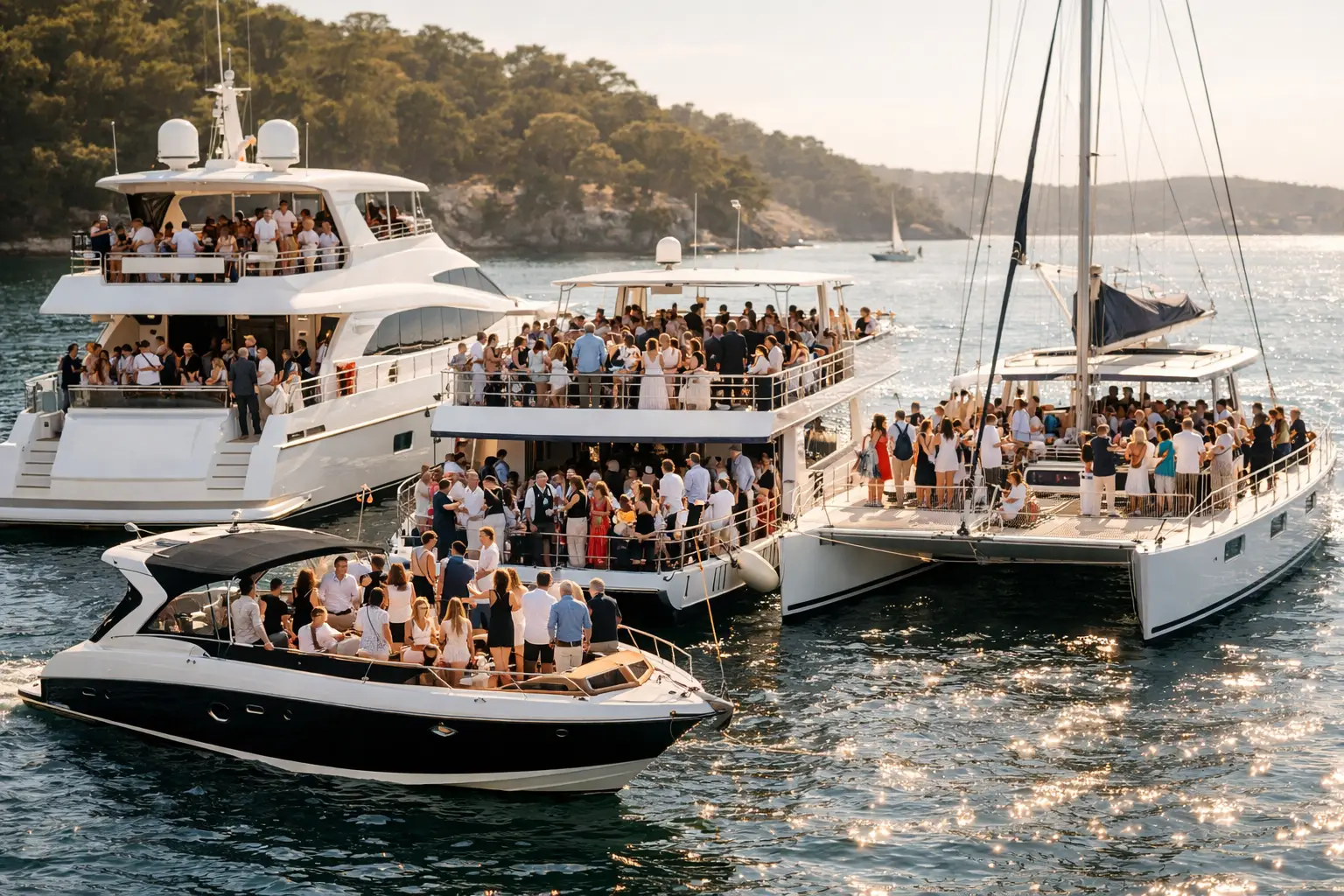
The answer was a raft-up format using multiple Australian-built party vessels connected into one floating event space. Rather than splitting the group into separate charters, the vessels were arranged to work as one venue with a shared visual identity, coordinated crew service, and a natural flow between decks.
This format gave the event an important advantage: guests could choose their own pace. Those looking for conversation could settle into lounge-style seating away from the main sound system. Guests who wanted to be in the middle of the action had open entertaining decks, music, and a more animated social atmosphere. Nobody was isolated on the “quiet boat” or stuck in a crowded central area.
The layout also made the event feel bigger in the right way. It was expansive, not scattered. Every deck had a purpose, and every space contributed to the same celebration.
Creating zones without dividing the crowd
A successful large-format charter should never feel like guests have been assigned to sections. The goal is to create movement and discovery without making people feel separated from the party.
In this case, the connected vessels supported a few clear experiences: an arrival and welcome area, relaxed lounge zones, food and beverage service points, open social decks, and a focal entertainment space. Because guests could circulate easily, the crowd naturally redistributed throughout the event. That reduced pinch points around bars and catering while keeping the central energy visible from every part of the setup.
This is one of the strongest reasons to choose a multi-vessel event. Space is not just about capacity. It is about what the group can do comfortably once everyone is onboard.
The atmosphere starts before departure
Large events can lose momentum during boarding if arrivals feel disorganized. For this celebration, the guest journey was treated as part of the experience rather than a logistical necessity.
Crew welcomed guests, directed them toward the right areas, and helped the group settle in quickly. The food, drinks, deck setup, and music were ready from the outset, so there was no awkward period where guests waited for the event to begin. By the time the vessels were underway, conversations were already flowing and the atmosphere was established.
That early momentum matters for corporate hospitality in particular. When clients, colleagues, and senior guests arrive to a confident, well-hosted environment, the organizer gets to enjoy the event too instead of managing details from the sidelines.
Hospitality Was the Main Event
For premium events, catering cannot be an afterthought. Guests remember whether the food was easy to enjoy, whether service felt attentive, and whether the overall offering suited the occasion.
The onboard menu was designed for a social format: freshly prepared food that could be served efficiently and enjoyed while guests moved between decks. The beverage service was equally considered, with crew keeping the experience welcoming and well-paced throughout the charter.
The key was not simply offering more. It was making sure the hospitality matched the scale and rhythm of the event. A 150-guest party needs smart service placement, clear timing, and enough crew presence that guests are looked after without the decks feeling overly formal.
True Blue Fleet’s all-inclusive event model is built around this kind of planning. The boats bring the visual impact, but it is the combination of crew, catering, service, sound, and event coordination that turns a charter into a hosted occasion.
What Changed When the Sun Went Down
As daylight softened, the multi-vessel format came into its own. The harbor became the backdrop, deck lighting elevated the atmosphere, and the event shifted naturally from a relaxed afternoon gathering into an evening celebration.
This transition is easy to underestimate. On land, an organizer might need to move guests between venues or reset an entire room to create a new mood. On the water, the changing light, city skyline, music, and open decks do much of that work. The event evolves without interruption.
Guests who had spent the afternoon talking in lounge spaces drifted toward the main entertainment area. Others remained on the outer decks, taking in the view and enjoying a more relaxed conversation. Both experiences felt intentional because the layout gave each one room to exist.
The Trade-Offs Organizers Should Consider
A multi-vessel party is not automatically the right answer for every group. For 30 to 50 guests who want one intimate shared setting, a single large vessel can create a stronger sense of togetherness. For an event with formal presentations, award segments, or detailed brand activations, the production plan should be discussed early so the setup supports the program.
Weather planning also matters. A professional operator will build the day around conditions, route options, timing, and crew guidance. The best on-water events feel effortless to guests because the operational details have already been considered behind the scenes.
For larger groups, though, the benefits are substantial. Multiple vessels offer more usable space, better circulation, a wider range of social settings, and a venue that immediately signals this is not an ordinary group outing.
The Result: A Party That Felt Personal at Scale
The strongest outcome of this event was not the headcount. It was that a large group still felt connected. Guests were free to circulate, form smaller conversations, and choose their own experience, yet the visual energy of the raft-up kept everyone part of the same celebration.
That is the real value of a well-planned multi-vessel format. It gives an organizer the scale required for a major event without sacrificing the warmth, comfort, and social momentum that make private charters memorable.
If your guest list is growing beyond what one deck can comfortably hold, start by thinking about the experience you want people to have between the big moments. The right floating venue gives every guest a place in the celebration, and that is what they will remember long after they step ashore.