
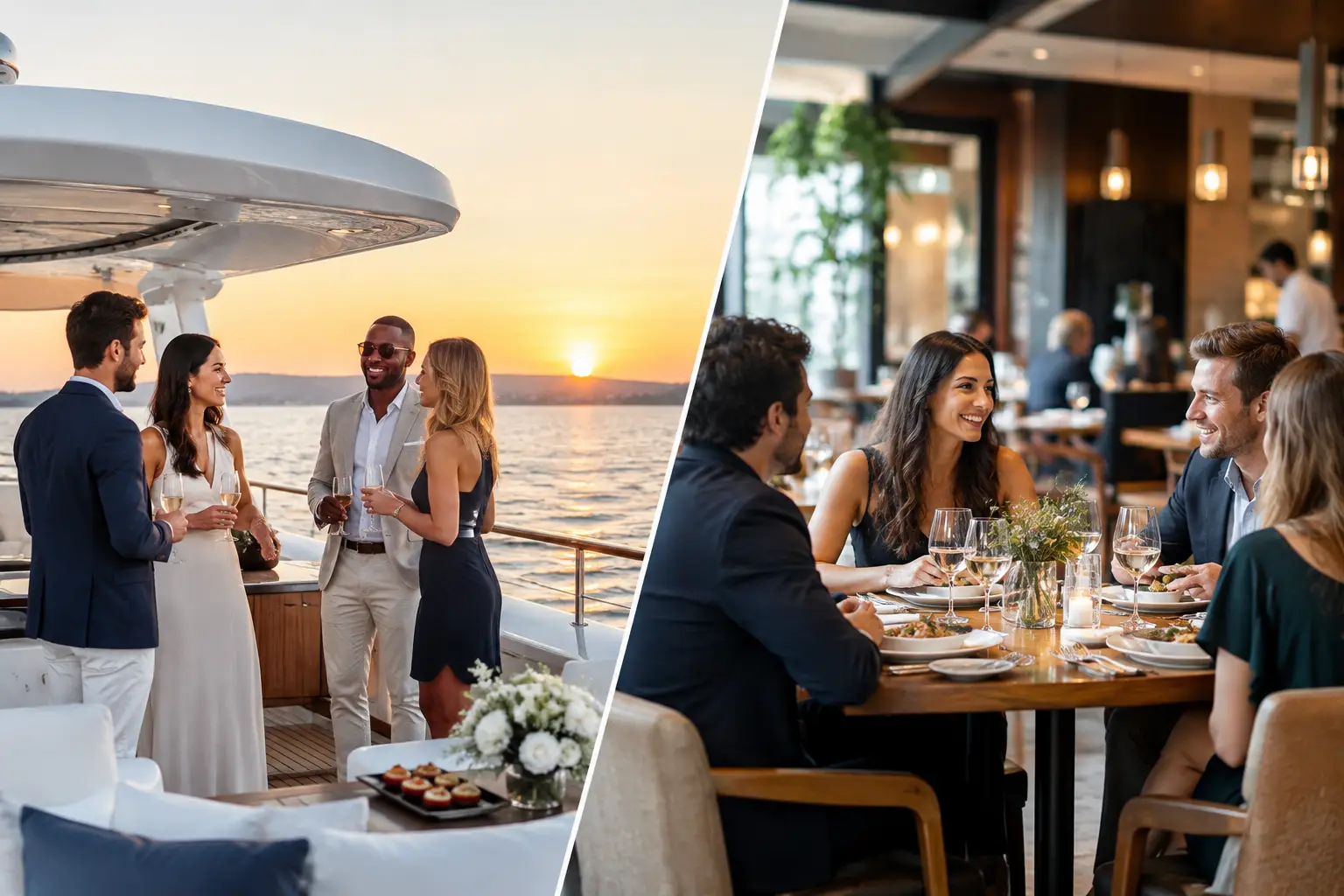
A restaurant can host a beautiful celebration. But when the guest list matters, the setting has to do more than provide a table and a menu. The boat reception versus restaurant decision is really about the kind of energy you want people to feel from the moment they arrive: a conventional dinner reservation or a private event with the harbor as its backdrop.
For birthdays, client entertaining, team celebrations, and milestone occasions, both formats can work. The stronger choice depends on your group, your priorities, and whether you want the venue to be part of the conversation.
Boat Reception Versus Restaurant: The Real Difference
A restaurant is designed around dining. A private boat reception is designed around gathering. That distinction changes the rhythm of the entire event.
At a restaurant, guests typically arrive, find their table, order or receive courses, and stay largely within one room. It is familiar, polished, and easy to picture. For a small group focused on an exceptional meal and uninterrupted conversation, that structure can be exactly right.
A boat reception creates movement and variety without asking guests to change venues. People can settle into lounge seating, step onto an open deck, take in the skyline, move between food, drinks, music, and conversation, then watch the atmosphere shift as daylight gives way to evening. The setting does some of the hosting for you.
That is especially valuable when the event needs to feel distinct from a standard work dinner or another birthday at the same familiar venue. A floating venue brings a natural sense of occasion before the first toast is made.
Atmosphere Is More Than a View
A waterfront restaurant may offer a great view, but your group is still one part of someone else’s service. Other tables are nearby, the soundtrack belongs to the venue, and the room’s pace is built for its full dining floor rather than your occasion alone.
On a private charter, the event has its own identity. Your guest list fills the space. Your music sets the tone. The catering and drinks are planned around your group, while the crew keeps the experience moving at the right pace. Rather than trying to make a restaurant feel like your event, you begin with an event venue that happens to be on the water.
For social groups, that extra space matters. A long restaurant table can divide conversations into pockets, with guests speaking mostly to the people beside them. Lounge-style decks encourage people to circulate naturally. Colleagues meet outside their usual teams. Friends reconnect without being locked into assigned seating all night.
The visual impact also lasts beyond the event itself. Sunset light, open water, distinctive decks, and a city skyline create the kind of setting guests want to photograph because it genuinely feels special, not because a decorative corner was added for the occasion.
When a restaurant has the edge
Restaurants have clear advantages for certain plans. If the group is intimate, the priority is a chef-led tasting menu, or several guests need a short and highly predictable evening, a private dining room may be the practical fit. Restaurants also suit events where formal presentations, tightly timed courses, and minimal movement are central to the agenda.
The point is not that one format is universally better. It is that a restaurant excels at restaurant dining, while a private boat excels at making a group celebration feel like an experience.
Privacy, Control, and Hosting Without the Friction
The biggest difference between a boat reception and a restaurant is control. Even a restaurant buyout can come with fixed layouts, defined service rules, sound limits, venue branding, and timing shaped by the kitchen’s wider schedule. You may have exclusivity, but not necessarily flexibility.
A charter gives organizers more room to shape the guest experience. Want a relaxed afternoon built around swimming, sun, and food on deck? Want a sunset client function with a polished welcome, catered service, and room to mingle? Want a birthday that begins laid-back and builds into a high-energy evening? The same vessel can support different moods because the event is private from the start.
That does not mean every detail should be overplanned. The best receptions leave room for spontaneous conversations and memorable moments. It does mean that the essentials – boarding, food service, music, seating zones, timing, and guest comfort – should be handled professionally so the host can be present rather than troubleshooting.
This is where an experienced charter operator earns its place. True Blue Fleet, for example, pairs spacious Australian-built entertainment vessels with onboard catering, professional crew, lounge-style layouts, and event planning that is built for groups rather than individual diners. For larger celebrations, connected vessels can create one striking venue for up to 150 guests.
Food and Drinks: Choose the Experience, Not Just the Menu
Restaurant menus can be impressive, but they are often optimized for a dining room and a course-by-course evening. That can be perfect for guests who want to focus on the meal. For a reception, however, food needs to support social flow.
On a boat, catering can be paced around the day rather than forcing the event into a single seated service. Guests can eat, return for a conversation, take in the view, and move between deck areas without the room going quiet while everyone waits for the next course. The right menu should be freshly prepared, easy to enjoy in a social setting, and substantial enough to keep guests comfortable throughout the charter.
Beverage service follows the same principle. A well-hosted reception is not about pushing volume. It is about having thoughtful options, attentive service, and a pace that keeps the event welcoming from first arrival through the final farewell. Premium hospitality feels generous and considered, never chaotic.
When comparing packages, ask what is genuinely included. A lower restaurant minimum can quickly grow once you add private-room fees, service charges, a required beverage spend, cake handling, décor, extended hours, and entertainment. A well-built charter package can make planning more straightforward by bringing venue, crew, catering, drinks, sound, and event atmosphere together.
Weather and Guest Comfort Need a Real Plan
Weather is the most obvious reason some organizers hesitate over a boat reception. It should be considered seriously, not brushed aside. A good event operator plans around seasonality, departure timing, route, shade, cover, and guest comfort well before the day itself.
The key is choosing a vessel designed for entertaining, not simply transport. Open deck space is a major draw, but guests also need practical places to relax, get out of direct sun, and enjoy the event if conditions change. Ask about the boat’s layout, covered areas, boarding process, restroom facilities, and the operator’s approach to weather decisions.
A restaurant has the advantage of four walls and fixed climate control. A boat has the advantage of atmosphere that cannot be replicated indoors. For many groups, the answer comes down to date flexibility and season. If your event must proceed in any conditions at a precise hour, a restaurant may reduce variables. If the goal is a standout occasion and you can plan intelligently around the elements, the water is hard to beat.
Which Option Fits Your Guest List?
Think about how guests will behave, not just how many are coming. A group of 20 executives may prefer a refined dinner if the agenda is relationship-building through focused conversation. The same 20 people may get far more from a charter if the brief is recognition, celebration, or relaxed client hospitality.
Boat receptions are particularly strong for groups that want to mingle across departments, friend circles, or client teams. They also work beautifully when the host wants guests to arrive to an immediate sense of anticipation rather than walk through a restaurant entrance and wait for a table.
For larger events, scale becomes even more decisive. Finding a restaurant that feels private, spacious, and energetic for a big group can be difficult. Multiple rafted vessels can turn that challenge into an advantage, creating distinct areas for dining, lounging, music, and conversation while keeping everyone within one connected event setting.
Make the Venue Match the Moment
Choose a restaurant when the meal is the main event and a formal, contained evening serves the group best. Choose a private boat reception when you want the venue itself to create momentum: open decks, changing views, room to move, personal hosting, and an atmosphere your guests will talk about after they step back onto shore.
The most helpful question is simple: will your guests remember where they sat, or how the whole occasion made them feel? Start there, and the right venue becomes much easier to choose.